
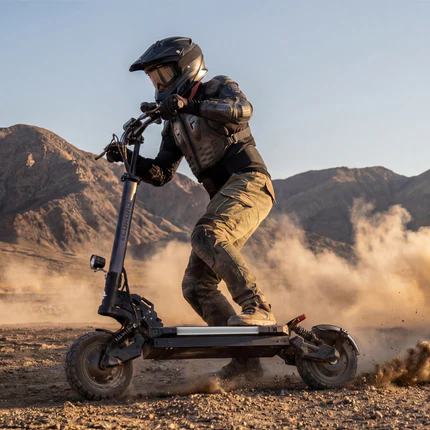
80 km is the Ceiling: Here's How to Stay Close to It
The ECOROAD ES6 Dual is rated for approximately 80 km of range on its 48V 15.6Ah battery. Although that figure is achievable, it's achieved under optimal conditions such as moderate speed, flat terrain, light rider weight, and good battery health. Real-world riding in cities like Toronto, Calgary, or Ottawa introduces variables that reduce that number. The good news is that most of those variables are things you can actively manage. The riders who consistently get close to 80 km aren't doing anything complicated; they've just built a handful of habits that compound into meaningfully better range per charge.
The Variables That Affect ES6 Dual Range Most
Before getting into the fixes, it helps to understand what's actually costing you kilometers. These are the biggest contributors to range reduction on the ES6 Dual:
- Speed - the relationship between speed and battery draw isn't linear; riding at 45 km/h instead of 35 km/h doesn't use slightly more battery, it uses significantly more due to wind resistance increasing with the square of speed
- Rider weight and load - the ES6 Dual supports up to 150 kg, but the motor works harder at higher loads, particularly on inclines and during acceleration
- Terrain - hills, loose surfaces, and rough pavement all increase motor demand compared to flat, smooth road; off-road trail sessions yield noticeably less range than flat city commutes.
- Temperature - lithium-ion batteries operate less efficiently below 10°C; in Canadian winters, expect a 15-25% range reduction compared to summer performance
- Battery health - poor charging habits accelerate capacity loss and reduce available range progressively over months of use
- Tire pressure - underinflated tires increase rolling resistance, which costs battery power per kilometer consistently
Speed Mode Selection: The Highest-Impact Adjustment
The ES6 Dual's four speed modes (15 / 24 / 35 / 55 km/h) are range management tools as much as they are performance settings. The difference in battery consumption between Mode 2 (24 km/h) and Mode 4 (55 km/h) on a flat urban commute is significant.
As a practical guide: use Mode 1 (15 km/h) in crowded urban areas and zones with pedestrian traffic, Mode 2 (24 km/h) as your default cruising speed for most city riding, and Mode 3 (35 km/h) for open bike lanes and clear stretches. Reserve Mode 4 for specific situations where the full speed is genuinely needed while always being within your province's legal e-scooter speed limits.
Most riders who switch from defaulting to Mode 3 or 4 to defaulting to Mode 2 notice a range improvement of 20-30% on the same route. The ride takes marginally longer, but the battery extends significantly.
Riding Technique That Extends Range
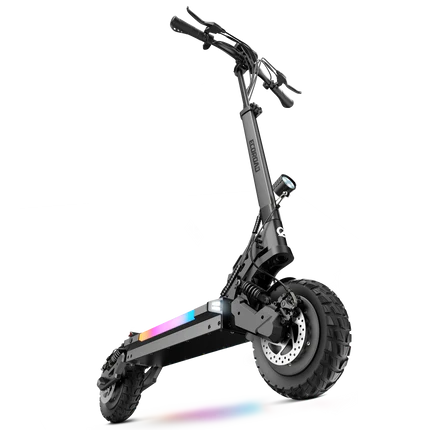
How you apply the throttle has as much impact on range as which mode you choose.
Smooth acceleration from stops is the single most effective technique habit for range extension. Hard throttle from a standing start pulls peak current from the battery. This is the kind of draw that's hardest on cells and least efficient in terms of energy-to-distance conversion. Building speed progressively over two to three seconds uses the same energy more efficiently.
Anticipate stops rather than reacting to them. Lifting off the throttle early when you see a red light or pedestrian crossing ahead lets the ES6 Dual decelerate naturally before braking. That coasting phase costs nothing from the battery and reduces the subsequent acceleration demand when you restart.
Use the terrain. On downhill sections, lift off the throttle and let gravity do the work. The electronic braking system captures a small amount of energy back into the battery during deceleration — a consistent contribution across a full ride.
Tire Pressure and Maintenance Checks
The ES6 Dual's 10×3.0-inch pneumatic off-road tires perform best at the correct pressure specified in the owner's manual.
Tires that are even 20-25% below the correct pressure increase rolling resistance noticeably. For a scooter covering 30+ km in a session, that resistance compounds into real range loss. Check pressure before every longer ride, and at a minimum, weekly for daily riders.
Beyond tire pressure, these monthly checks protect the range over time:
- Inspect tires for embedded debris that causes slow leaks.
- Check that both brakes release cleanly because dragging brakes adds consistent resistance that costs range per kilometer.
- Confirm the folding mechanism is fully locked, since any play in the stem creates micro-vibration that increases riding effort.
- Check the charging port for debris before every charge session.
As ECOROAD's article on why brakes are the most important feature on an electric scooter covers, properly functioning brakes also affect riding efficiency. A clean brake release is as important as stopping power for range management.
Charging Habits That Protect Long-Term Range
The ES6 Dual's 80 km range is the range it has on day one with a healthy battery. The charging habits you build from that first day determine how much of that range you still have after one year of daily Canadian riding.
Charge at 20-30%, not at zero.
Regular full-discharge cycles are the fastest way to reduce lithium-ion capacity over time. Charging before the battery drops below 20% keeps cells in their most stable operating range.
Unplug at 100%.
The battery management system (BMS) protects against overcharge, but sustained full-charge voltage still creates low-level cell stress. Unplug when the charge is complete rather than leaving it connected overnight indefinitely.
Charge at room temperature, especially in winter.
In Canadian cities like Winnipeg or Edmonton, where winter temperatures regularly fall below -15°C, bring the scooter indoors and let the battery warm to room temperature before plugging in. Charging cold lithium-ion cells significantly accelerates capacity loss and is one of the most common sources of premature range degradation for Canadian riders.
Keep the daily charge between 30-80% for regular commuting.
Reserve full 100% charges for trips where you genuinely need the maximum range.
For the broader picture on why the ES6 Dual makes financial sense as a daily rider, and how battery efficiency connects to cost savings, ECOROAD's piece on electric scooters as a green commuting solution covers the numbers clearly.
How the ES6 Dual Compares to Other ECOROAD Canada Models on Range
Context helps. The ES6's 64 km range sits between the ES4 (56 km, 800W motor) and the ET6 (55 km, 800W motor) in the ECOROAD Canada lineup. While the range advantage isn't dramatic, the ES6 distinguishes itself with a more powerful 1000W motor, larger off-road tires, and a suspension setup designed for mixed-terrain riding.
Riders focused primarily on lightweight urban commuting may find the ES4 sufficient for daily travel. Those who value comfort and long-distance cruising may lean toward the ET6. However, for riders who want stronger acceleration, better traction on gravel or uneven surfaces, and the flexibility to transition between city streets and recreational trails, the ES6 offers the most balanced combination of power, versatility, and range in the current ECOROAD Canada lineup.
Small Habits, Real Kilometers
Getting close to the ES6 Dual electric scooter's 80 km range isn't about restricting how you ride, but about riding efficiently within the same route. Speed mode discipline, smooth throttle habits, correct tire pressure, smart charging habits, and winter battery care each contribute additional range individually. Combined consistently, they're the difference between a scooter that feels like it underdelivers and one that consistently meets or exceeds expectations.
What Riders Usually Ask
What is the real-world range of the ES6 Dual electric scooter in Canada?
Under typical mixed urban conditions, expect a 55-68 km range. The 80 km rated range reflects optimal conditions; Canadian winters reduce this further by 15-25%.
Does using dual motors reduce range compared to a single motor?
Yes. Dual motors draw more combined current, which is why the ES6 Dual's 80 km range is slightly lower than that of other single-motors
How much does speed mode affect the ES6 Dual's range?
Significantly, riding in Mode 2 (24 km/h) instead of Mode 4 (55 km/h) can extend range by 25-35% on the same route, making mode selection one of the highest-impact range management decisions.
How does Canadian cold weather affect the ES6 Dual's range?
Below 10°C, expect a 15-25% range reduction; always bring the scooter indoors to warm before riding in cold weather, and charge at room temperature to protect long-term battery capacity.
How often should I check tire pressure for optimal ES6 Dual range?
Weekly for daily riders, and before any ride covering more than 25 km, underinflated tires increase rolling resistance consistently across every kilometer ridden.